
Advanced Prostate Treatment Β· Now Available at Tees Urology
Aquablation Therapy
Robotic waterjet surgery for benign prostate enlargement β precise, effective, with significantly lower risk of sexual side effects


PATIENT SATISFACTION (WATER II TRIAL)
TYPICAL PROCEDURE TIME
RISK OF RETROGRADE EJACULATION VS TURP
NIGHTS HOSPITAL STAY (TYPICALLY)
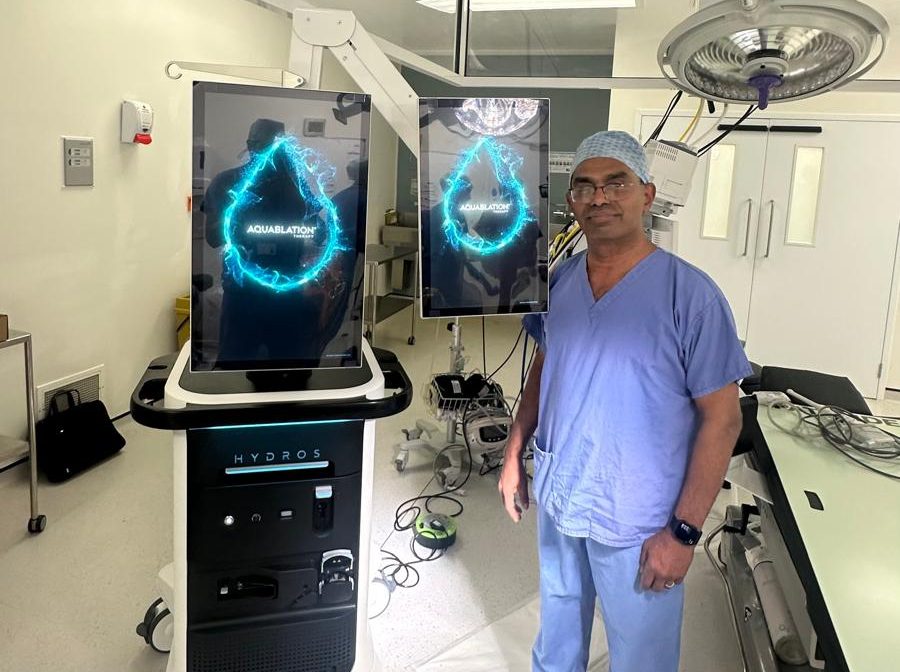
What Is Aquablation?
Aquablation (AquaBeam Robotic System) is a next-generation surgical treatment for Benign Prostatic Hyperplasia (BPH) β commonly known as an enlarged prostate. It was approved by NICE (National Institute for Health and Care Excellence) in 2021.
Unlike traditional prostate surgery (TURP) which uses heat from electrical current or laser energy, Aquablation uses a high-velocity waterjet to precisely remove the excess prostate tissue. The procedure is guided by real-time ultrasound imaging and controlled by a robotic system, allowing the surgeon to plan the exact tissue to be removed before any cutting begins.
The absence of heat is the key difference. Heat-based techniques can cause collateral damage to the nerves and tissue surrounding the prostate β leading to sexual side effects. Aquablationβs waterjet removes tissue without thermal damage, resulting in significantly better preservation of sexual function.
It is particularly effective for men with larger prostates (30β150cc) where other minimally invasive treatments may be less suitable.
In Plain Terms
Aquablation is a computer-guided water treatment for an enlarged prostate. The waterjet is so precise it removes exactly the right amount of tissue β not too little, not too much β without the burns or heat damage that older techniques can cause. The surgeon plans the entire procedure first, then activates the system. It typically takes less than an hour.
Who Is Aquablation For?
Aquablation is suitable for men with confirmed benign prostate enlargement who are experiencing symptoms that affect their quality of life.
You may be a good candidate if you have:
Aquablation may not be suitable if you have:
STEP BY STEP
How Does Aquablation Work?
A four-stage surgical process guided by real-time imaging and robotic precision
Ultrasound Mapping
A transrectal ultrasound probe creates a detailed real-time image of your prostate. Mr. Jesuraj uses this to draw the precise boundaries of tissue to be removed β planning the treatment before it begins.
Robotic Execution
The AquaBeam robotic system executes the pre-planned waterjet path with sub-millimetre accuracy. The high-velocity saline jet cuts through prostate tissue cleanly without heat or electrical energy.
Haemostasis
After the waterjet phase, Mr. Jesuraj uses a brief cautery step to manage any bleeding from the treated area. A catheter is placed overnight while the prostate begins to heal.
Recovery
Most patients go home after 1β2 nights. The catheter is usually removed before discharge. Urinary symptoms improve over the following weeks as the prostate heals and shrinks.
Aquablation vs. Traditional TURP
How does Aquablation compare to the conventional surgical standard?
| Feature | Traditional TURP | AquablationTees Urology |
|---|---|---|
| Method of tissue removal | Electrical current (heat) | High-velocity waterjet (no heat) |
| Surgical guidance | Visual / surgeon eye | Real-time ultrasound + robotic |
| Risk of retrograde ejaculation | High (up to 90%) | Significantly lower |
| Suitable for large prostates | Technically challenging | Yes β up to 150cc |
| Procedure time | 60β90 min | Under 60 min (waterjet phase) |
| Thermal tissue damage | Yes | None |
| NICE approved | Yes | Yes (2023) |
| Urinary symptom relief | Good | Comparable β with better side effect profile |
Your Aquablation Journey
BEFORE
You will be asked to stop certain blood-thinning medications in advance. Full written instructions will be provided.
DURING
AFTER
FOLLOW-UP
Benefits at a Glance
A note on sexual function: Aquablation does not preserve ejaculation in all patients, but the risk of retrograde ejaculation is significantly lower than with TURP. Men for whom this is a priority concern should discuss it specifically with Mr. Jesuraj.
Risks & Considerations
As with all surgical procedures, Aquablation carries risks. Mr. Jesuraj will discuss these with you in detail at your consultation so you can make a fully informed decision. The most commonly discussed risks include:
Frequently Asked Questions
Interested?
Book a consultation with Mr. Jesuraj to find out if you are a suitable candidate. Appointments available within days.
Aquablation Therapy
Robotic waterjet surgery for benign prostate enlargement β precise, effective, with significantly lower risk of sexual side effects
What Is Aquablation?
Aquablation (AquaBeam Robotic System) is a next-generation surgical treatment for Benign Prostatic Hyperplasia (BPH) β commonly known as an enlarged prostate. It was approved by NICE (National Institute for Health and Care Excellence) in 2021.
Unlike traditional prostate surgery (TURP) which uses heat from electrical current or laser energy, Aquablation uses a high-velocity waterjet to precisely remove the excess prostate tissue. The procedure is guided by real-time ultrasound imaging and controlled by a robotic system, allowing the surgeon to plan the exact tissue to be removed before any cutting begins.
The absence of heat is the key difference. Heat-based techniques can cause collateral damage to the nerves and tissue surrounding the prostate β leading to sexual side effects. Aquablation’s waterjet removes tissue without thermal damage, resulting in significantly better preservation of sexual function.
It is particularly effective for men with larger prostates (30β150cc) where other minimally invasive treatments may be less suitable.
In Plain Terms
Aquablation is a computer-guided water treatment for an enlarged prostate. The waterjet is so precise it removes exactly the right amount of tissue β not too little, not too much β without the burns or heat damage that older techniques can cause. The surgeon plans the entire procedure first, then activates the system. It typically takes less than an hour.
Performed at:
Ramsay Tees Valley Hospital, Middlesbrough
Offered by:
Mr. Manohar Jesuraj β Consultant Urological Surgeon
Who Is Aquablation For?
Aquablation is suitable for men with confirmed benign prostate enlargement who are experiencing symptoms that affect their quality of life.
β You may be a good candidate if you have:
- A confirmed diagnosis of BPH (enlarged prostate)
- Symptoms that have not improved adequately with medication
- A prostate volume between 30β150cc
- Significant urinary symptoms: slow flow, incomplete emptying, frequency, nocturia
- Concerns about sexual side effects from traditional surgery
- Previously failed RezΕ«m or other minimally invasive treatment
βΉοΈ Aquablation may not be suitable if you have:
- A prostate smaller than 30cc (other options may be better)
- Active or recent urinary tract infection
- Certain coagulation disorders or bleeding risk factors
- Suspected prostate cancer (this must be excluded first)
A full consultation with Mr. Jesuraj is required to confirm suitability. All appropriate investigations will be discussed and arranged.
How Does Aquablation Work?
A four-stage surgical process guided by real-time imaging and robotic precision
Ultrasound Mapping
A transrectal ultrasound probe creates a detailed real-time image of your prostate. Mr. Jesuraj uses this to draw the precise boundaries of tissue to be removed β planning the treatment before it begins.
Robotic Execution
The AquaBeam robotic system executes the pre-planned waterjet path with sub-millimetre accuracy. The high-velocity saline jet cuts through prostate tissue cleanly without heat or electrical energy.
Haemostasis
After the waterjet phase, Mr. Jesuraj uses a brief cautery step to manage any bleeding from the treated area. A catheter is placed overnight while the prostate begins to heal.
Recovery
Most patients go home after 1β2 nights. The catheter is usually removed before discharge. Urinary symptoms improve over the following weeks as the prostate heals and shrinks.
Aquablation vs. Traditional TURP
How does Aquablation compare to the conventional surgical standard?
| Feature | Traditional TURP | Aquablation Tees Urology |
|---|---|---|
| Method of tissue removal | Electrical current (heat) | High-velocity waterjet (no heat) |
| Surgical guidance | Visual / surgeon eye | Real-time ultrasound + robotic |
| Risk of retrograde ejaculation | High (up to 90%) | Significantly lower |
| Suitable for large prostates | Technically challenging | Yes β up to 150cc |
| Procedure time | 60β90 min | Under 60 min (waterjet phase) |
| Thermal tissue damage | Yes | None |
| NICE approved | Yes | Yes (2021) |
| Urinary symptom relief | Good | Comparable β with better side effect profile |
* Clinical comparisons drawn from the WATER and WATER II randomised controlled trials. Individual results vary. Mr. Jesuraj will discuss your specific situation at consultation.
Your Aquablation Journey
Pre-Operative Assessment
You will attend a pre-operative consultation with Mr. Jesuraj. This will include a review of your symptoms, flow rate test, bladder scan, PSA blood test, and a discussion of the procedure, risks, and expected outcomes. A PSA result and prostate volume measurement are required before proceeding.
You will be asked to stop certain blood-thinning medications in advance. Full written instructions will be provided.
The Procedure
Aquablation is performed under general or spinal anaesthesia. The waterjet phase of the procedure typically takes under 60 minutes, though total theatre time including preparation and haemostasis is longer. You will wake up with a urinary catheter in place.
Recovery at Home
Most patients are discharged after 1β2 nights. The catheter is generally removed before you go home, once the nursing team confirms you are voiding safely. You should expect:
- Some urinary urgency and frequency for the first few weeks β this is normal
- Possible blood-stained urine for 1β2 weeks
- Avoid heavy lifting, driving, and strenuous activity for 2β4 weeks
- Return to desk work within 1β2 weeks for most patients
- Significant symptom improvement typically noticed within 4β8 weeks
Post-Operative Review
Mr. Jesuraj will review you in clinic after the procedure to assess your recovery and symptom improvement. A flow rate test and bladder scan are repeated to confirm a satisfactory outcome. Your GP will receive a full discharge summary.
Risks & Considerations
As with all surgical procedures, Aquablation carries risks. Mr. Jesuraj will discuss these with you in detail at your consultation so you can make a fully informed decision. The most commonly discussed risks include:
- Retrograde ejaculation β lower risk than TURP but still a possibility; semen travels backward into the bladder during orgasm rather than being ejaculated
- Bleeding β blood in the urine is expected initially; significant bleeding requiring re-intervention is uncommon
- Urinary urgency / temporary worsening β the bladder can be irritable for several weeks post-operatively
- Urinary tract infection β a common risk with any catheter-based procedure
- Need for further treatment β in a small proportion of patients, a second procedure may be required
- Erectile dysfunction β uncommon; risk is lower than TURP due to absence of thermal damage
Benefits at a Glance
- NICE approved, evidence-based treatment
- Highly effective symptom relief (comparable to TURP)
- No heat β lower risk of sexual side effects
- Suitable for larger prostates
- Short hospital stay (1β2 nights typically)
- Robotic precision removes guesswork
- Long-lasting results
- Performed by an experienced consultant urologist
Aquablation Treats These Conditions
Frequently Asked Questions
Is Aquablation available on the NHS?
Aquablation is NICE approved and is available in some NHS centres, however waiting times can be considerable. Tees Urology offers it privately with appointments usually within days and treatment within weeks.
Will I still be able to have an erection after Aquablation?
The risk of erectile dysfunction following Aquablation is low β comparable to or lower than TURP β because the procedure does not use heat, which can damage the nerves involved in erection. The majority of men retain erectile function post-procedure.
What about ejaculation?
Retrograde ejaculation (where semen goes backward into the bladder) is a known risk of all prostate operations. Aquablation has a significantly lower rate than TURP. This does not affect sexual pleasure or the ability to orgasm, but does affect fertility. Discuss this with Mr. Jesuraj if it is a concern for you.
How long do the results last?
Clinical trial data shows durable results at 5 years, with the majority of patients maintaining significant improvement in symptoms without requiring further treatment. Long-term data continues to be gathered as Aquablation is a relatively new technique.
How do I know if my prostate is too large or too small for Aquablation?
Aquablation is validated for prostates between 30cc and 150cc. A prostate volume measurement (usually via transrectal or transabdominal ultrasound) will be performed as part of your pre-operative assessment. Mr. Jesuraj will advise whether another treatment would be more appropriate for your prostate size.
Is it covered by health insurance?
Coverage depends on your individual policy. Mr. Jesuraj is recognised by all major UK insurers including BUPA, AXA, Vitality, Aviva, and Cigna. We recommend contacting your insurer in advance with the procedure code to confirm your cover. Our team can assist with this process.
What is the cost of Aquablation at Tees Urology?
Please contact us directly for a cost breakdown, as Aquablation fees include both consultant professional fees and hospital facility costs at Ramsay Tees Valley Hospital. We provide full, transparent costings before you commit to any treatment. See our Fees page for our consultation and standard procedure costs.
Interested in Aquablation?
Book a consultation with Mr. Jesuraj to find out if you are a suitable candidate. Appointments available within days.
